Opening a Food Business? Get all Your Answers Here : An Exclusive Interview with Ravi Wazir
In the challenging world of hospitality, true success hinges on more than just good food and decor. It demands understanding people, keen business sense, and resilience. Few understand this better than Ravi Wazir, a veteran hospitality consultant, author, and mentor with over three decades of experience.
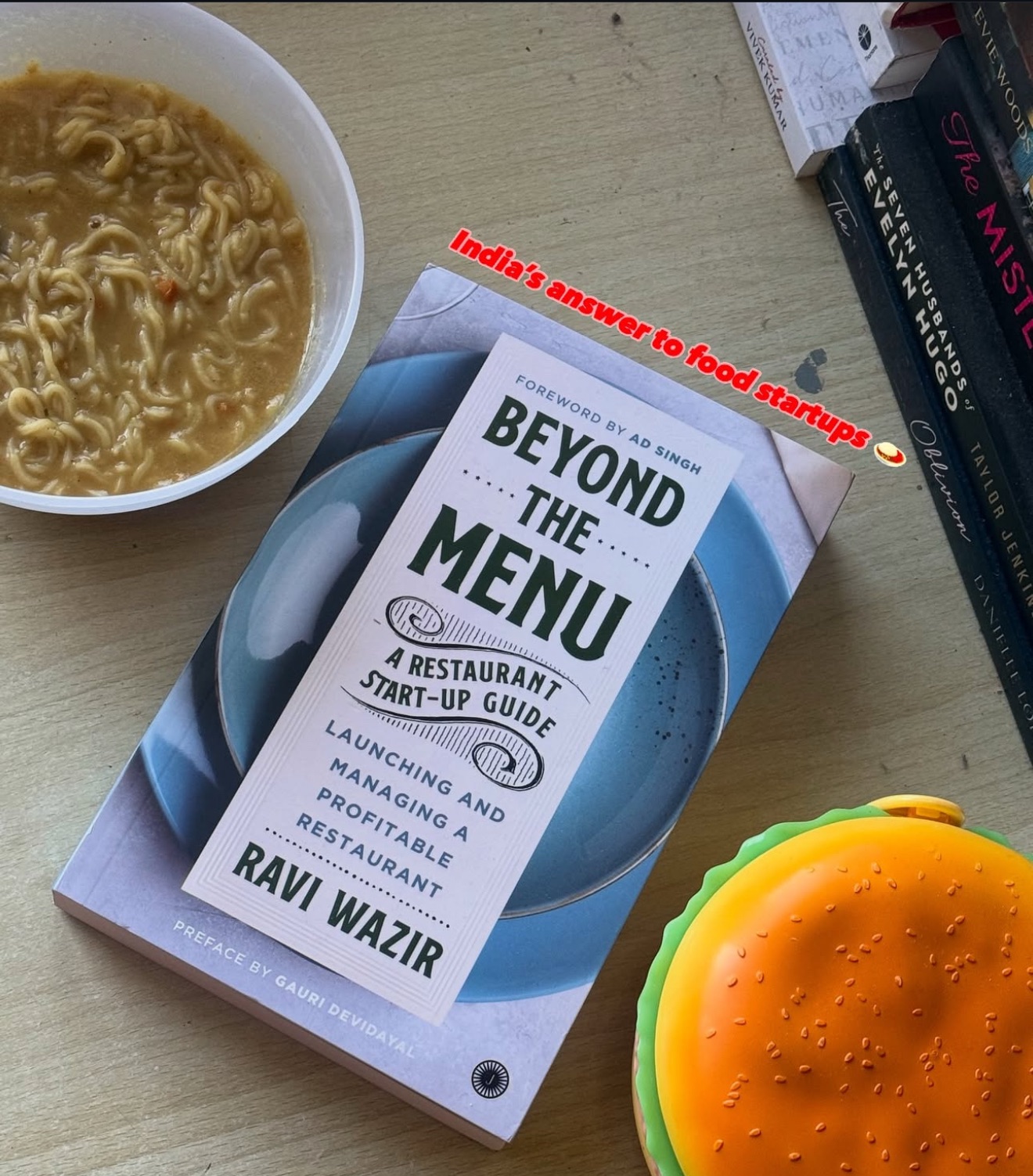
From his early days watching his grandfather run a hotel in Kashmir, to his extensive career as an employee, a successful entrepreneur, and now a sought-after consultant, Ravi Wazir helps clients understand what truly makes a hospitality business thrive. He is the author of “Beyond the Menu: A Restaurant Start-up Guide: Launching and Managing a Profitable Restaurant,” a “no-nonsense roadmap” that cuts through conventional wisdom to deliver practical insights for aspiring and established restaurateurs alike.
I recently sat down with Mr. Wazir to get his knowledge. We explored overlooked elements that differentiate success from survival, common entrepreneurial pitfalls, and the changing landscape of the F&B industry. His answers offer a candid look into the heart of hospitality.
The Interview
1) What would you say is the single most critical, often overlooked, non-menu element that differentiates a thriving restaurant from one that merely survives?
Answer: Even before hotel school or working in the industry, I learnt one of the biggest ‘secrets’ of hospitality by watching my grandfather run his hotel in Kashmir. Guests loved him not just for his food, but for how he made them feel.
He had this quiet way of tuning in to people’s needs…offering picnic baskets for their treks or handing out warm kangdis (portable coal heaters) before anyone even asked. That thoughtfulness stayed with me.
A restaurant or any other F&B business is just a stage. What really matters is the experience we create for our guests. We’re in the people business, and we just happen to serve food.
How we treat our guests, our teams, and our vendors all affect how the business performs. So that overlooked but critical element is people!
2) Having worked both as an employee and as an entrepreneur before becoming a consultant, how did these experiences uniquely shape your understanding of the common pitfalls and blind spots entrepreneurs tend to have when starting their ventures?
Answer: In their purest form:
An employee follows the owner’s direction.
An entrepreneur takes ownership as if their life depends on it.
And a consultant brings clear-eyed, unbiased objectivity.
Now picture this:
An entrepreneur gets too emotionally attached to a decision and loses objectivity.
An employee casually racks up expenses, unaware of the financial pressure the founder is under.
A consultant gives advice but has never risked even a single rupee in running a business.
Having worn all three hats, I’ve learnt to switch perspectives based on the situation. That mix of ownership, empathy, and objectivity has shaped my understanding in a way that’s hard to teach…but crucial for avoiding common pitfalls.
3) Your firm offers “turnaround assistance.” In the hospitality sector, what is the most common underlying problem, beyond just financial issues, that necessitates a business turnaround, and what’s your initial step in diagnosing it?
Answer: The first thing I check is whether the business’s value proposition is aligned with what its customers need and want. Misalignment here is usually the root of most business problems.
Often, it’s the founder’s attachment to their original idea…that blocks progress. That’s why I only take on turnaround projects where the entrepreneur is truly open to learning and change.
Once that openness is there, we dig into what the target audience really responds to and then reshape the offering to meet that demand. That’s where turnaround begins.
4) The book promises a “no-nonsense roadmap.” What’s one piece of conventional wisdom or popular myth about the restaurant business that you consider to be pure “nonsense” and actively advise your clients to discard?
Answer: A lot of aspiring restaurateurs believe that having a few great recipes or hiring a rock-star chef is all it takes. That if they build it, guests will magically show up.
But here’s the truth: passion and good food are not enough. This is why my book is called “Beyond the Menu”. If your financials don’t work, if the numbers don’t add up…you’re headed for trouble, no matter how great your menu is.
That’s the reality I keep reminding my clients of….”Great food matters, but a solid business model matters just as much”.
5) You’ve helped set up several brands and organisations. What’s the biggest challenge you’ve observed in translating a unique restaurant concept into a tangible, marketable, and sustainable brand identity in today’s competitive F&B landscape?
Answer: It’s Execution!!
Strategy and execution are two very different beasts. A lot of entrepreneurs struggle to even see the full picture during planning, so when it comes to execution, things fall apart. That’s when the financial and emotional toll kicks in.
Without strength in both areas, many are forced to shut down.
I’ve written about these challenges (and solutions) in my book, but I also created a free online quiz to help aspiring restaurateurs self-assess: Take the Quiz here – https://raviwazir.com/quiz/quiz1/
It takes 30–40 minutes and gives each person a tailored report…what they’re good at, what needs work, and what blind spots might hurt them if left unaddressed.
6) “Few new eateries survive,” your text states. Beyond the typical business reasons, what human or psychological factor in the entrepreneur often contributes most significantly to a new restaurant’s early demise?
Answer:
- Bad timing: Sometimes the concept is already dated, or it’s too early for the market. Either way, the audience just isn’t ready.
- Improper funding: Running out of money happens way more often than you’d think, especially when there’s no buffer for working capital or the unexpected.
- Lack of consistency: Whether it’s the food, the service, or the drive to keep improving, inconsistency kills trust…and with it, repeat business.
7) When advising on “Organising your team,” what’s one counter-intuitive approach you suggest for building a highly effective and loyal staff in a sector known for high turnover?
Answer: I often recommend hiring people with mid-level or even no formal qualifications…especially those who’ve proven themselves through hands-on work.
Sometimes, the most loyal and hard-working team members don’t speak fluent English or don’t “look the part.” But if they’ve already shown commitment and the right attitude, they’re worth investing in…through training, upskilling, and support.
Skills can be taught. Attitude shaped. Loyalty is earned, not taught.
Unfortunately, many entrepreneurs overlook the talent hiding in plain sight…right under their noses.
8) Given your decades of experience, could you share an example of a less obvious but highly effective operational strategy that drastically improved efficiency or customer satisfaction for one of your clients?
Answer: There are several in my book, but here’s a simple one I refined while working with a client’s restaurant.
Guest feedback forms were either ignored or skimmed through. At best, upset guests were offered a free dish on their next visit…but many never returned. Quietly, the brand was losing patrons.
So, I shifted the approach…
Instead of penalising staff for negative feedback, I made sure they were heard…by me. That built trust, and they stopped hiding guest complaints.
Some of that feedback revealed operational issues, which we fixed. Other comments pointed to service gaps that became topics in our team briefings.
I personally read and responded to every single piece of guest feedback, every day. I also explain the what, how, and why of my responses to the senior team…so they could learn from it, and take the practice forward.
It wasn’t just about replying to guests. It was about creating a culture where feedback actually shaped the experience…both for customers and for the team.
9) Your consulting firm started in 2003. How have the fundamental principles of “money, marketing, and manpower” in the restaurant industry been irrevocably altered by the digital revolution (e.g., social media, food delivery apps) since you began consulting?
Answer:
- Marketing: The way restaurants market themselves has completely changed. It’s all about how people consume content now…quick, image-heavy, mobile-first, and online. Attention spans are shorter, so messaging needs to be snappy and visually engaging.
- Money: Back in the day, funding was often thrown around without much diligence. Today, investors are far more disciplined. No one’s writing cheques without a clear proof of concept…meaning a business that’s either already profitable, or headed there.
- Manpower: This one’s huge. Earlier, team members worked crazy hours, often without weekly offs. Now, people value balance. They’re asking for (and often getting) better work conditions, structured time off, and growth paths beyond the kitchen and the floor.
About the Book: “Beyond the Menu: A Restaurant Start-up Guide”
“Beyond the Menu: A Restaurant Start-up Guide: Launching and Managing a Profitable Restaurant” is your no-nonsense roadmap to becoming a restaurateur. Venturing into the restaurant business is a popular choice today, yet few new eateries survive. It’s important to discover how to manage business risks and make well-informed choices for your restaurant start-up before you go live. This book is packed with information on the nuts and bolts of the restaurant industry as well as techniques to handle money, marketing, manpower, and operational issues. Top business consultant Ravi Wazir shares proven techniques and strategies honed by 1hospitality professionals over decades.
You can find “Beyond the Menu” here: https://amzn.in/d/caFCeDN
About the Author: Ravi Wazir
Ravi Wazir has worked in the hospitality sector as an employee, an entrepreneur, and a consultant for over two decades. He has experience in businesses from hotels to fast-food outlets, from catering services to restaurants, and has helped set up several brands and organisations. In 2003, he started a business consulting firm offering start-up, developmental, and turnaround assistance to entrepreneurs in the trade. His articles have been published in both industry journals and the popular press. He has also helped organise and spoken at several industry events. Ravi currently lives in Mumbai, India, with his wife and two kids.
Connect with Ravi Wazir
Learn more about Ravi Wazir’s work and connect with him through the following channels:
- Website: https://raviwazir.com/
- LinkedIn: https://www.linkedin.com/in/ravi-wazir/
- Facebook: https://www.facebook.com/ravi.s.wazir
- Instagram: https://www.instagram.com/ravi_wazir/
- YouTube: https://www.youtube.com/@RaviWazir
You can also reach him directly at raviwazir@gmail.com or +91 9819231353.