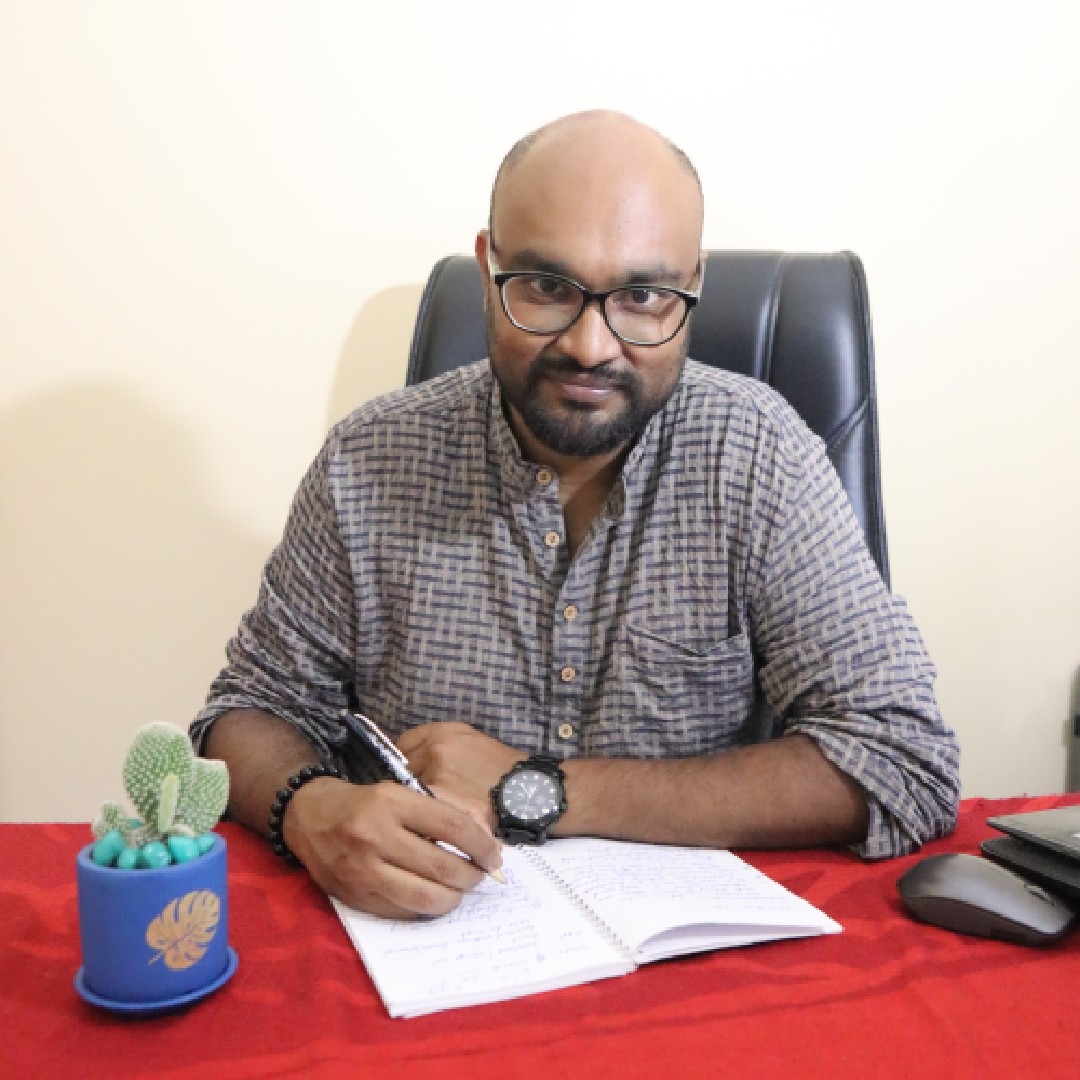
What if the stories of gods and demons you grew up with were only half the truth? In a market flooded with retellings, author Jayanth Dev dares to ask this question, not just as a whisper, but as a “War of Justice Against the Gods.”
His new book, Dhantasura, reimagines the Hindu Itihasa from the perspective of a character lost to the “silences” of history: Dhantasura, the grandson of Mahishasura. It’s a story born from dreams, challenging the very nature of dharma and divinity.
We sat down with Jayanth Dev to discuss the inspiration behind his epic new trilogy, his unique “Dream Writer” process, and how his career in digital marketing shapes his creation of mythological worlds. You can purchase his books on Amazon.
1. Your work reimagines the Hindu Itihasa from the perspective of a lesser-known character, Dhantasura. What inspired you to explore the story of Mahishasura’s grandson and challenge the conventional narrative of gods and asuras?
I’ve always been drawn to the silences in our ancient stories. Everyone knows the victory songs of the gods, but no one stops to ask what it meant for the defeated, their families and their legacy. Dhantasura was born from that silence. He’s the grief of a grandson who didn’t inherit glory, but pain. For me, it was never about glorifying demons or vilifying gods. It was about asking: what if the story you know is only half the truth?
2. You’re known as a “dream writer,” with many of your stories originating from your dreams. Was there a specific dream or series of dreams that sparked the creation of Dhantasura?
Yes. I actually saw Dhantasura three times in my dreams. The first time, he appeared like a huge bird passing by. The second time, he came and sat on a massive building, but still too far for me to clearly see. The third dream was the most powerful. Dhantasura landed right in front of me on a stone arch. Later, I was amazed to find that exact place near Ambajogai. It’s called the Shivleni Caves. That moment connected dream and reality for me, and that’s when I knew this story was waiting to be born.
3. The central theme of Dhantasura is a “War of Justice Against the Gods,” questioning the very nature of dharma. What philosophical questions are you hoping to provoke in your readers by portraying the gods as fallible?
We have forgotten the way we look at or understand God. Today, we think very materialistically, almost like gods are only wish-granters or problem-solvers. But divinity is something much deeper, much different. My book is thought-provoking in a way that I am offering knowledge that comes from how nature itself works and how the gods move through that nature to teach us something important. The idea is not to attack belief but to awaken a different perspective on what we call dharma.
4. Beyond being an author, you have a successful career as a digital marketer and entrepreneur. How does your experience in branding and storytelling for major companies influence your fiction writing?
Marketing taught me one thing clearly: stories are built to move people. When I write, I apply the same thinking. Every character has to connect like a brand. Every scene has to leave an impact like a campaign. My entrepreneurial side pushes me to look beyond just writing a book and instead think of how a story can be felt like a movement.
5. Dhantasura is the first book in a planned trilogy. Can you give your readers a glimpse into the larger arc of Dhantasura’s journey? What can they expect in the upcoming installments?
The first book is about inheritance. The second is about the revolt itself, where Dhantasura rises not just as a warrior but as a voice for the voiceless. The third will be the reckoning. Not just war, but consequences. Readers can expect politics, betrayals, and truths that will shake their understanding of divinity and evil. One more thing I’d add here is this: when the Sheera Sagara (churning of the milky ocean) was done, nectar didn’t come first. Many other things emerged before Amrutam. My story is like that. What you see in the first part is only the beginning. The true nectar of Dhantasura’s journey will reveal itself slowly.
6. The character of Guru Parashurama plays a significant role in advising Dhantasura. What was your thought process in choosing him as a mentor?
Parashurama is a paradox. He’s a sage, but also a warrior drenched in blood. He understands both rage and discipline. For Dhantasura, who is torn between revenge and justice, there could be no better guide. He’s not just a mentor; he’s also a reminder of what happens when dharma itself turns blurry. Personally, I also believe in Parashurama, and I believe he is still on earth. Maybe that’s why all my books carry his name or his reference somewhere. That is my offering to him, my way of keeping him alive in my work.
7. Your writing blends known historical/mythological events with your own fictional narrative. How do you balance staying true to the source material with the creative freedom to build a new story?
I stay true to the soul of the stories, not the line-by-line details. The essence, the values, and the cultural roots are respected. But within that soil, I allow myself to create new branches. I don’t see it as rewriting; I see it as expanding. The ones we call villains also deserve their side of the story.
8. You’ve also authored I Met Parashurama and Escaping the Unknown. How has your writing style and approach to storytelling evolved with each book, leading up to the epic scale of Dhantasura?
My first book, I Met Parashurama, was very personal. Escaping the Unknown was more experimental, playing with survival and fear. By the time I reached Dhantasura, I had found my true voice. Bold, unapologetic, and not afraid to challenge even the gods. Each book taught me something and prepared me for the epic scale of this one.
9. In a market with a growing interest in mythological fiction, what do you believe makes Dhantasura stand out?
Most books retell what we already know. I chose to tell what was never told. Dhantasura doesn’t glorify heroes; it gives humanity to the so-called villains. It’s not mythology for comfort; it’s mythology for confrontation. That’s what makes it different.
10. For aspiring authors who, like you, have diverse professional backgrounds, what is the most crucial piece of advice you would offer for balancing their careers with their passion for writing and getting their stories told?
Don’t wait for balance. It doesn’t exist. If your story burns inside you, you’ll find a way to write. Use your professional skills as weapons to help your writing, not excuses to avoid it. And most importantly, write the story only you can write. That’s your biggest edge.
From a dream at the Shivleni Caves to a full-blown epic that challenges our deepest-held beliefs, Jayanth Dev’s Dhantasura is more than just a mythological novel. It’s an invitation to question, to explore the silences, and to understand that every story has more than one side.
Are you ready to hear the other side of the story? Dhantasura is available now online and in major bookstores.
What are your thoughts on challenging traditional narratives in mythology? Share your views in the comments below!